Loading preview...

Start a project
Reach out to us for any inquiries or support.

Contact
We’re here to help you with all your needs.

Call Us
Get in touch with our team anytime.
How We Help
Why Venveo
Resources
Get weekly data — and insights.


Venveo is an award-winning digital marketing solutions provider. Since 2003.
©2026 Venveo

Zach Williams
Owner & Founder, Venveo

Most of our discovery calls with manufacturing companies start with this question:
What's your goal with marketing?
A popular, somewhat obvious answer would be: more sales, more leads, more business.
Ironically, this simple answer is also the reason why so many manufacturing brands struggle with achieving lasting results with marketing in the first place: vague goals translate into vague results.
“Try everything and see what sticks”, “we just need more leads”, “everyone does digital marketing, and so should we” is not a steady impactful marketing strategy. To have a long-lasting success in marketing, digital or not, manufacturers need to become very aware about their goals and how they can achieve them.
For that reason, the first part of this article will cover a framework that will make sure every marketing campaign you launch produces real results. The second part of this article will showcase specific marketing campaigns and strategies that manufacturing companies can employ right away to produce results.
At first glance, all marketing strategies for manufacturers look very diverse: it’s hard to see commonalities between SEO, social media marketing, public relations, referral marketing, or paid advertising.
But every successful marketing strategy has the same three well defined components. These three components are: scope, audience, and goal.
Examples of the framework in use:
Increase sales of a [specific product] among [homebuilders] in [two US states] by [X%].
Raise the number of [company] [trade media mentions, podcast appearances, number of readers...] in the [manufacturing industry] within the [next 3 months] by 20%.
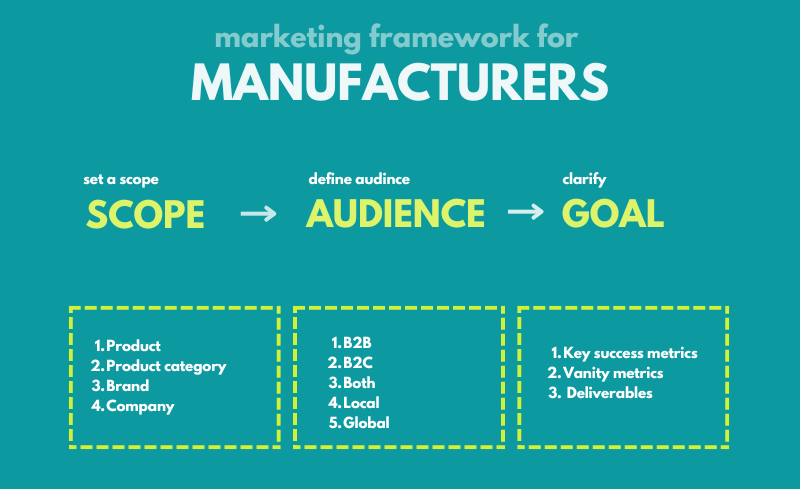
The first thing you need to determine for every marketing campaign as a manufacturer is the scope.
It's tempting to declare scope "everything everywhere at once", but that usually leads to bloated markting budget and mediocre results on all fronts.
Instead, ask yourself these questions:
Establishing a specific scope helps properly allocate resources and focus, two things that most marketing campaigns lack.
When your goal is to market a specific product, you will see what marketing strategies, channels, and assets will be the most efficient for this task. For example, you will not be spending money on ineffective ad campaigns that attract visitors but do not result in sales of this specific product. You will also quickly (within days) eliminate channels with poor conversion, rather than continue pouring money into underperforming channels for weeks and months.
The common mistake we observed is assigning "large scale" to any marketing effort you run. Obviously, as you increase the scope, you increase expenses. You also switch your marketing from tactical, precise actions to more strategic outlook, and that prevents you from finding creative ways to outperform your competition in specific niches and regions.
It’s always better to have several marketing campaigns of various scopes running at the same time rather than trying to create a huge, all-encompassing one marketing initiative. If you have a strategic goal of growing all digital conversions by 200%, the most effective way to achieve it is to develop several sub campaigns with varying scopes.
Properly defining target audience is crucial for every business, and even more so for manufacturers due to sheer variety of marketing targets.
Manufacturing marketing campaigns can target wholesalers, retailers, distributors, industrial buyers, procurement managers, supply chain managers, engineers, designers, consultants, integrators, chief executives and many more. And each of these campaigns will require a different approach.
These questions asked early will greatly enhance the performance and success chance of your marketing campaigns:
Are we targeting B2B, B2C clients, or both? Are we targeting a global or localized audience?
What is the typical buying process and decision-making hierarchy for our target customers?
What specific pain points or challenges does our target audience face that our product solves?
What channels (e.g., trade shows, social media, industry publications) does our target audience use to gather information and make purchasing decisions?
Defining and researching your target audience is a critical step for any marketing manufacturing campaign, so we recommend further reading these guides to help you in this process:
Practical Guide to Buyer Personas for Manufacturing Companies
Lead Generation for Manufacturers: 23 Best Ways To Attract Industrial Leads
Mastering Market Research for Manufacturers: Product to Strategy
Properly defining goals for every marketing company you launch will help you:
The common goal “more sales” is too vague to help you and often serves more like a short-term motivation. A 15% increase in local (eg. US oe “Texas”) sales-qualified lead inquiries for a specific product line will work much better.
Here are a few question that will help you set up and execute marketing goals in manufacturing:
What is our key conversion event? (a sale, an inquiry, a lead, a website visit. etc.)
What is our target customer acquisition cost (CAC), and how does it compare to the lifetime value (LTV) of our customers?
How will we measure the ROI of different marketing channels and tactics?
With the rise of the digital age, digital marketing has taken off as an effective way to educate an audience, build trust, generate leads, and drive sales. Plus, it requires no paid advertising to pull it off, just quality content and a strong sense of direction. Sound too good to be true? Let’s walk through a handful of marketing strategies you can start using as a manufacturer, with real-world examples of how they work.
It’s easy to think you know your market as a manufacturer, but do you? Consumer behaviors and preferences have experienced a stark shift over the past few years, and that means more manufacturers have begun opening new sales channels, like direct-to-consumer eCommerce websites where DIYers and homeowners can purchase products straight from them. This might not be ideal for your business, but it just goes to show how much an industry can change in a few short years.
If you haven’t conducted some in-depth market research within the last year or two, it’s high time to dive in and see what’s changed. Even if you don’t open up a whole new marketing channel, you can take this opportunity to further refine your target customer personas (like by leveraging the wealth of data and BI tools available today) and rethink how you’re approaching marketing at a high-level.
In addition to reviewing who you're targeting, market research will also give you the chance to think about when, where, and how. Competitor research should definitely be part of your process, and it can reveal new features you might want to incorporate, new places to market your business, and new ways to connect with your target customer base.
One thing is for certain: If you conduct market research before revising your marketing plan, you’ll be far better positioned to select and implement strategies effectively. So, let’s dive into a handful of tactics you might decide to utilize.
For manufacturers aiming to stand out, a key lesson lies in creating a recognizable and memorable brand that resonates with your target audience, be it homeowners, professionals, or dealers. While visual elements like logos and colors are significant, they form just a part of the story.
Central to a successful brand is a strong value proposition that addresses the key challenges and pain points of your end-users. This involves conveying in your marketing campaigns that your products not only meet but exceed standard expectations in terms of usability, efficiency, and performance.
In branding, it's crucial to go beyond superficial features like attractive packaging or a sleek website. Establishing a powerful brand in manufacturing involves a few strategic steps:
By focusing on these aspects, manufacturers can create a brand that not only stands out in the market but also firmly establishes its value in the minds of its customers.
Content marketing efforts can take your business a long way when it comes to driving organic traffic and attracting leads, but what happens when a potential customer picks up the phone to talk to your company? Or even a customer who’s been with your business for some time?
Consumer expectations are changing and that means any customer you work with — whether end user or middleman who has to serve the end user — needs prompt, reliable, and friendly service. The thing is, while you may have a well-staffed service center, you may not be empowering your representatives to go above and beyond in their interactions with leads and customers.
While top-tier service may be one of your values on paper, actually carrying it out in the real world is a whole lot tougher. Home Depot invests in their representatives through an array of learning and development programs to “expand skills and capabilities so associates can master their current roles and prepare for future ones.” By making sure reps are knowledgeable, supported, and satisfied, Home Depot is able to deliver consistently great service.
If you need help empowering your reps, take these pointers:
Your manufacturing brand simply wouldn’t be recognizable if you did not back every promise made on your product with case studies, photos, videos, and articles to explain and prove the key benefits. Create a resource hub — one that’s itching to explain every aspect of your brand’s large product line while reeling customers in with benefit-focused copy, and you will reap immediate benefits of content marketing for manufacturers at work.
Content marketing can cover many different channels and formats. By utilizing a variety of content types, each intentionally targeted as a certain persona (homeowner, professional, or dealer) at a certain point in the decision-making process, you will effectively generate, nurture, and funnel leads to a purchase.
Your brand can utilize all of the same content marketing strategies:
Especially when you’re working with a new or revolutionary product that breaks the mold, you should always lean into showing instead of telling. Kebony, a manufacturer of wood cladding, sat down with Venveo in Episode #144 to discuss how video has helped grow the brand. One of the company’s most successful endeavors so far has been its Design vs. Build series, which won several Telly awards in 2020.
In Design vs. Build, each video features a building project and interviews both the architect and builder involved. “Oftentimes, you'll hear from an architect and they are very easy to talk to about the project because they are bringing all the vision. But, it's the builders who have to make that vision a reality,” explains Ben, creator of the series. It’s an interesting take, no doubt, but what’s really powerful about the series is that Klebony explicitly avoids mentioning the brand.
While you don’t have to avoid brand mentions altogether to do content marketing the “right” way, Klebony’s choice to cut out all mentions of the company (while still featuring Klebony products on screen) takes the “show instead of tell” notion to new heights. Not only has this helped them gain publicity for the series, and the subsequent awards, but it keeps an audience truly engaged without the annoyance of built-in advertising.
Here are all the ways you can use video marketing:
There are many different types of distributors that you can work with as a manufacturer, but simply signing a contract is far different from becoming a valued partner. While getting a contract with a distributor is great, taking things a step further will help you ensure that your contract is renewed year after year.
For example, you can have a page containing a hub of resources targeted at distributors of your manufacturing products, designed not only to make the life of distributors easier, but also improve the in-store shopping experience for end customers.
While it may take years to build up a resource, there are some elements you could start working on right away:
Social media is often overlooked by manufacturers, but it’s a highly effective tool for market players big and small. Mandy Sancic, co-owner of Olde Wood Limited, which manufacturers reclaimed wood for flooring and other products, proved this point when she sat down with Venveo to reveal how the company used Instagram to grow the brand to 12,000 followers in just a few months.
No matter who you’re targeting as a manufacturer, there is a social media network (or multiple) where your audience can be found. That in-depth market research discussed above can help you identify these networks if you aren’t sure where to look. Once you’re there, remember that social media isn’t just for regurgitating your website content.
If there’s one thing many manufacturers are not doing, it’s offering gated content. While putting resources up on your website is great, ask yourself: Is there a single video, resource, or download that requires users to enter an email address (or any other info) in order to access it? If not, you’re leaving leads on the table.
There are pros and cons to gated content, and it’s not always the top priority for big recognizable brands that have such a far reach and lock on the market, but what about for your brand? Gated content just means taking some of the valuable resources you’ll be working on for your website and asking users to provide their email address in exchange for access.
By gating content, you can create a sense of exclusivity around your best tools and information while also building out your list of leads. Venveo uses this exact method for some super high-value resources, like our Marketing to Builders Research & Trends Report. Some other examples of content that can be effectively gated for lead generation include:
Email marketing costs pennies on the dollar to execute and can be highly automated, creating an extremely low-cost but high-potential means of communicating with leads and customers. Innovate Building Solutions has been leveraging email marketing for years and company president Mike Foti told Venveo they’ve organically generated a list of more than 23,000 emails — and counting.
Of course, effective email marketing means avoiding the spam folder and making your content compelling enough that subscribers actually want to open it, time after time. One key to achieving this reality is to use segmentation to your advantage, and send at a regular cadence without overwhelming people.
Innovate Building Solutions leaves no room for guessing. There are multiple paths to signing up for the company’s newsletter, whether you outright click the “subscribe” button or opt-in through one of the various forms, like the “Free Estimate” option. The path you take and information you share in those forms helps the company automatically segment you to the right list, so you get the exact info you want and nothing else (like information on a bathtub to shower conversion or advice on building an ADA compliant restroom).
Here are some ways you can make the most of your email list:
Marketing will never run itself, but today’s powerful automation capabilities do allow you to get one step closer. With marketing automation, your business can stretch its budget that much further while taking a big weight off the shoulders of your team.
Schöck, a global manufacturer of structural building components based in Germany, says they use Salesforce to build automation around events, trade shows, and conventions, which play a big part in the brand’s global strategy. Big companies like Schöck simply couldn’t keep up without automation, and the tools they’re using are becoming more accessible to smaller players by the day.
If you aren’t sure what to automate or how, just look to all the moving parts in the strategies we’ve already discussed here:
Search engine optimization stays a reliable marketing channel for manufacturers for several reasons:
To learn more about the possibilities of SEO and the most efficient workflows, read our detailed guide on SEO For Manufacturers: 8 Tactics That Drive Results
These companies are inspiring examples of manufacturer marketing at work and these marketing strategies should get your brand off to a strong start, whether you’re getting online for the first time or trying to revamp your image.
By mixing, matching, and resizing to fit your company’s needs, you can get going with your new marketing plan in no time.
Need help? Venveo proudly stands in the gap between manufacturing companies and digital sales success. Our proven digital growth processes guide your business in finding and connecting with your audience online while compelling them to take action. Contact us to learn more about how Venveo can help your manufacturing company’s online presence.